

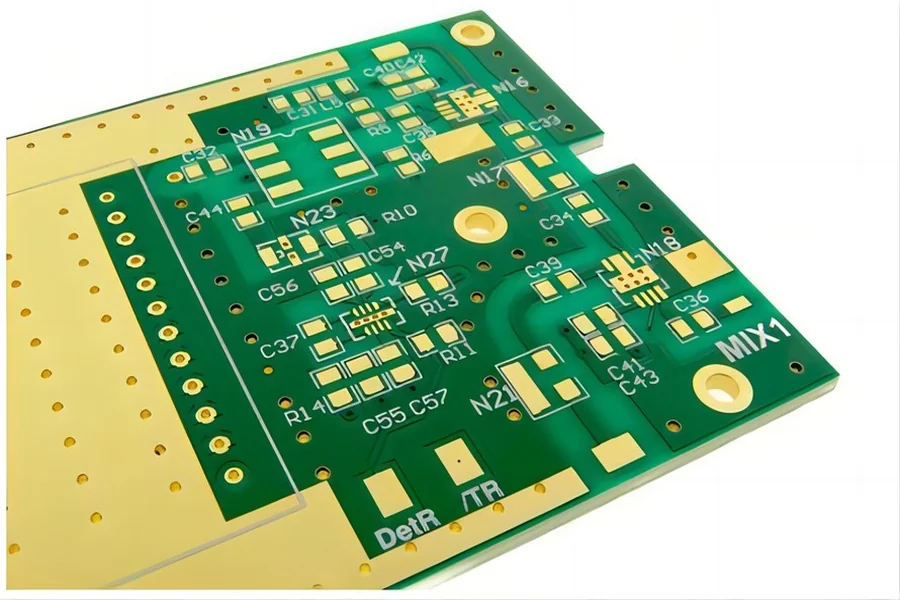
A microwave printed circuit board is a specialized type of PCB designed to operate at extremely high frequencies, typically ranging from hundreds of megahertz (MHz) to several gigahertz (GHz). These boards are essential in applications where signal integrity, low loss, and stable performance are critical. Unlike standard PCBs, microwave printed circuit boards use unique materials and design techniques to handle high-frequency signals without significant interference or degradation. They are a vital component in industries such as telecommunications, aerospace, defense, medical imaging, and radar systems.
Materials Used in Microwave Printed Circuit Board
One of the most important factors in designing a microwave printed circuit board is the selection of materials. Standard FR4 materials are not suitable for high-frequency applications because they have higher dielectric loss, which can distort signals. Instead, materials such as PTFE (Teflon), ceramic-filled laminates, and hydrocarbon-based composites are commonly used. These materials offer low dielectric constant (Dk) and low dissipation factor (Df), ensuring minimal signal loss and high stability over a wide frequency range. Advanced brands like Rogers, Taconic, and Isola produce high-performance laminates specifically engineered for microwave PCBs.
Design Considerations for Microwave Printed Circuit Board
Designing a microwave printed circuit board requires careful attention to impedance control, trace geometry, and dielectric spacing. High-frequency signals are sensitive to even small variations in trace width or copper thickness, so precise manufacturing tolerances are critical. Ground planes and shielding are often incorporated to reduce electromagnetic interference (EMI) and maintain signal integrity. Designers must also account for thermal management, as high-frequency components can generate significant heat during operation. Simulation software is frequently used to model signal behavior before fabrication begins, reducing the risk of costly design errors.
Applications of Microwave Printed Circuit Board
Microwave printed circuit boards are found in a wide range of advanced technologies. In telecommunications, they are used for cellular base stations, satellite communication systems, and high-speed data links. In the defense sector, they are critical for radar systems, missile guidance, and secure communication networks. Medical applications include MRI machines, patient monitoring equipment, and wireless medical devices. The automotive industry uses microwave PCBs in advanced driver-assistance systems (ADAS) and vehicle-to-everything (V2X) communication. The ability of these boards to deliver stable performance at high frequencies makes them indispensable in modern electronics.
Manufacturing Process of Microwave Printed Circuit Board
The manufacturing process for a microwave printed circuit board is more complex than that for a standard PCB. It begins with precise material cutting and lamination to ensure consistency in dielectric properties. The etching process must be tightly controlled to maintain exact trace dimensions. Special attention is paid to drilling and plating vias, as imperfections can cause signal reflections or losses. Some designs may require hybrid construction, combining different materials in a single board to optimize performance and cost. After fabrication, microwave PCBs undergo rigorous testing, including time-domain reflectometry (TDR) and vector network analysis, to verify their high-frequency performance.
Advantages of Microwave Printed Circuit Board
Microwave printed circuit boards offer several advantages over traditional PCBs. They provide excellent signal integrity at high frequencies, ensuring minimal loss and distortion. They can operate over a wide temperature range, making them suitable for harsh environments. Their materials are engineered for low moisture absorption, ensuring consistent performance in humid or variable conditions. Additionally, their precision design and manufacturing make them reliable for mission-critical applications where failure is not an option. These qualities make microwave PCBs a preferred choice for industries requiring cutting-edge communication and sensing technologies.
Challenges in Microwave Printed Circuit Board Development
While microwave printed circuit boards deliver outstanding performance, they come with challenges. Material costs can be significantly higher than standard PCB substrates, and specialized manufacturing processes may increase production time. Design tolerances are extremely tight, requiring advanced fabrication equipment and skilled engineers. Additionally, testing high-frequency boards demands sophisticated tools and expertise. Despite these challenges, the benefits of microwave PCBs far outweigh the drawbacks for applications that demand high-speed, high-reliability performance.
Choosing the Right Partner for Microwave Printed Circuit Board Production
The success of your high-frequency project depends heavily on selecting an experienced manufacturing partner. A skilled Microwave & RF PCB manufacturer can provide expert guidance on material selection, precision fabrication, and high-frequency testing. By working with a trusted partner, you can ensure that your microwave PCB meets strict performance requirements, passes rigorous quality checks, and is delivered on time. Partnering with the right manufacturer not only reduces the risk of costly rework but also accelerates your product’s journey from concept to market.
